A second opinion: reading a PEC Zwolle scouting dossier with a rating
2026-06-15
A few days ago Daan Stavorinus published an independent recruitment analysis for PEC Zwolle — a forty-page dossier prepared for the 2026/27 season. It is a serious piece of work. It runs as a funnel: from club context to playing style, from style to a squad-gap analysis, from gaps to role profiles, and only then to names, each one weighed against PEC's budget and the realistic transfer routes open to a club with one of the smallest wage bills in the Eredivisie. The discipline is the point. Not the availability of a name or an eye-catching statistic, he writes, but the need of the club decides the search.
This post is a reply to that dossier, written for its author and for anyone at the club who has to turn a shortlist into a signing. We ran the same question Daan asked — who fits, and who can we afford — through a different instrument: a cross-league player rating that scores some 76,000 footballers on one scale. The numbers agreed with his strongest calls, argued productively with a few, and surfaced a handful of names his toolkit could not reach. None of that replaces what he did. It sharpens the sieve and offers a second opinion. Where the two disagree is usually where the interesting questions live.
The gap a rating is built to fill
Daan is candid about his hardest problem. When the free advanced data behind FBref disappeared in January 2026, deep statistics for smaller competitions — the Keuken Kampioen Divisie, Scandinavia, Belgium — got much harder to come by. His honest workaround is a no-code stack (Transfermarkt, Sofascore, WhoScored, FootyStats, YouTube) and, crucially, an Opta-style competition weighting to compare numbers across leagues of very different strength. Data is a sieve, he writes, not an answer; video is the decisive instrument.
That competition weighting is exactly the seam where a rating earns its keep. A league-strength multiplier is a single constant applied to everyone in a division. It cannot tell you whether this second-tier defender will hold up a level higher. A rating can, because it is not a multiplier at all — it is one scale, learned from actual results, including the matches that bridge competitions: promotion and relegation, the cup, reserve sides playing seniors, continental ties, transfers that carry a player's level with them. Ratings of this kind are judged on whether they predict the next result, not on whether they flatter a reputation (Constantinou & Fenton, 2013) (McHale et al., 2012). For a club shopping precisely in the markets where data is thinnest, that bridge is the whole value.
The first thing worth saying, then, is unglamorous but important: every market in Daan's dossier is covered. The KKD, Eliteserien, the Allsvenskan, both Belgian tiers, the German third tier, the Danish and Croatian and Bosnian top flights — all of his candidates sit on the same rating scale as the PEC players they would replace. That is what lets the rest of this comparison happen at all.
Where the eye and the numbers agree
Start with the good news for the dossier: on the calls Daan is most confident about, the rating nods along. His primary centre-back target projects as a ready-made Eredivisie starter on our scale; his "dream" alternative sits a clear tier above that — which is exactly how he described the pair, one realistic and one aspirational. The agreement runs deeper than the headline number. We also build a style fingerprint for each player from his per-match actions — passing volume, key passes, tackles and interceptions, duels, dribbles, shots — measured not in raw counts but relative to players in the same position in the same league, so a KKD midfielder and an Eredivisie one can be read side by side. On those fingerprints, the destroyer Daan flagged as a ball-winner wins 60% of his duels in our data; the figure he quoted from a different provider was 62%. Two independent readings of the same player, pointing the same way. That convergence is the most reassuring thing a second opinion can offer, and it shows up again and again across his top picks.
Where they argue
The disagreements are more useful. Three are worth a scout's second look.
The first concerns his leading centre-back. By the rating he is a fine defender and an honest Eredivisie level — but his style fingerprint is almost a copy of the PEC defender he is meant to partner: both are calm, low-aggression, ball-playing centre-backs who avoid the duel. Daan's own profile for the role asks for the opposite — an aggressive, front-footed presence to complement the reader already there. The man who best fits that brief, on the fingerprints, is a name his funnel parked early for unrelated reasons. Worth reopening.
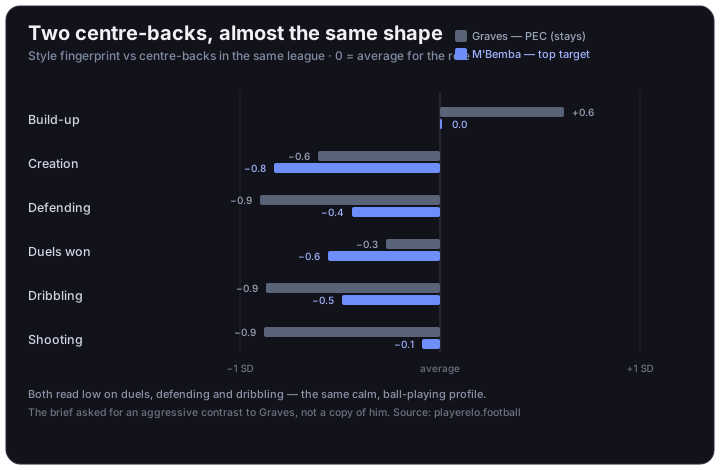
Style fingerprints, position- and league-relative (0 = average for the role). The target meant to complement the incumbent reads almost identically to him — the same low-duel, low-aggression profile, not the front-footed contrast the brief calls for.
The second concerns the midfield. PEC are losing a high-volume two-way engine in the centre. Daan's first and second choices to replace him are both good — but they are different jobs. His preferred name is a clean, low-risk ball-keeper who wins his duels but rarely starts them; his alternative is the truer like-for-like, with the duel volume and defensive work-rate of the man leaving. Neither is wrong. The rating simply makes explicit a choice the dossier leaves implicit: do you replace the profile you are losing, or partner the anchor who stays? That is a question for the bench, and now it has numbers attached.
The third is a caution about the rating itself. The exciting young number ten at the top of Daan's attacking-midfield list reads, on the fingerprints, oddly flat — modest on every axis. That is not the player being modest; it is the model being blind. His value is end-product, twelve goals and assists, and we have no expected-goals axis to capture it, because the underlying match files carry no shot data. For a pure finisher, lean on his output and his trajectory, not on this particular radar. A rating's blind spots are not failures to apologise for; they are the edges of what the number is allowed to know.
What the funnel couldn't reach
Then there is the part a rating does that a no-code funnel cannot: sweep every affordable league at once and rank the unknowns. We asked it a narrow question — for each of PEC's five priority positions, find players Daan did not list who fit the role profile, sit in the right rating and form band, are the right age, and play in a market the club can actually shop in. No Pedris. Just realistic, under-the-radar fits.
The most useful finding was geographic. Daan's longlist leans heavily on the KKD, which he mined thoroughly. The best new names the model returned sit instead in the Czech and Slovak top flights and the Belgian mid-table — precisely the "markets competitors skip" that his own strategy calls for, but which his tools could not search at scale. A cross-league rating has no such blind spot; a Slovan Bratislava ball-winner and a De Graafschap creator are just two more points on the same scale.
That is where the second instrument we leaned on this week matters. A rating tells you whether a player is good enough. It says nothing about whether you can afford him — so we went and got the prices, scraping each candidate's current Transfermarkt valuation directly. The exercise was a lesson in why fresh data matters. A snapshot from January would have called several of these players bargains; by June, the risers had risen out of reach. One Belgian winger had tripled to €5m. The standout young creator we almost recommended had gone from €150k to €2.5m in five months as his breakout season repriced him — the window, in other words, had already closed. And one name our rating liked, a reclamation-project centre-back, turns out to be listed as retired. The eye would have caught that; a stale spreadsheet would not.
So we ran the search a second time, now with the live price as a hard constraint rather than an afterthought — discarding anything above the club's ceiling before ranking on fit. What comes back is a genuinely affordable shortlist, and the same geographic pattern holds: the value is in the Czech and Belgian leagues and the Scandinavian mid-table, not the KKD Daan has already combed. A handful stand out. A Sparta Prague winger rated comfortably at Eredivisie level, available for €850k. A Liberec centre-back at €650k. The Guinean defender in Sweden, still €400k for an Eredivisie-capable level. None of them is a name you would recognise — which is rather the point.
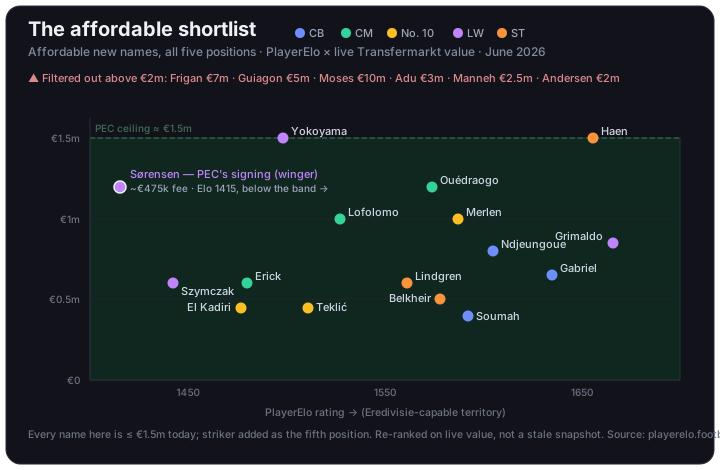
The affordable shortlist across all five positions, rating against live market value (June 2026). Everything sits at or under the club's ceiling; the striker Elias Sørensen prices in but is rated below the band; the eye-catchers from the first pass — the €5m, €7m and €10m names — are off the top, filtered out before ranking.
| Position | Player | Club (league) | Rating | Value | Read |
|---|---|---|---|---|---|
| Left wing | J. Grimaldo | Sparta Prague (Czech) | 1666 | €850k | Standout — elite rating, low price |
| Centre-back | Š. Gabriel | Slovan Liberec (Czech) | 1635 | €650k | Best rating for the money |
| Centre-back | J. Ndjeungoue | Kortrijk (Belgium 2) | 1605 | €800k | Eredivisie level, selling tier |
| Centre-back | M. Soumah | Sirius (Allsvenskan) | 1592 | €400k | Bargain, rising form |
| No. 10 | R. Merlen | St. Truiden (Belgium) | 1587 | €1.0m | Highest-rated affordable ten |
| Midfield | I. Ouédraogo | Odense (Denmark) | 1574 | €1.2m | Two-way engine, form rising |
| Midfield | E. Lofolomo | Zulte Waregem (Belgium) | 1527 | €1.0m | Ball-winner profile |
| No. 10 | I. El Kadiri | De Graafschap (KKD) | 1477 | €450k | Cheap, local, creative |
| Left wing | A. Yokoyama | Genk (Belgium) | 1498 | €1.5m | Squad player → loan realistic |
| Striker | M. Belkheir | RAAL La Louvière (Belgium) | 1578 | €500k | High shot volume, cheap |
| Striker | G. Lindgren | BK Häcken (Allsvenskan) | 1561 | €600k | Rising, high match rating |
| Striker | D. Haen | Willem II (KKD) | 1656 | €1.5m | Young, local, top rating |
One position Daan deliberately set aside for later is worth adding here, because the club is reportedly close to acting on it: the back-up striker. The brief is a mobile, sharp finisher to play against the grain of Kostons, the target man — and it is the one role where the model is at its weakest, because there is no expected-goals axis, so a finisher's defining skill is invisible to it. Read with that caveat, the affordable options cluster in the same leagues as the rest: Häcken's Gustav Lindgren at €600k, rising and reliable; Willem II's Devin Haen at €1.5m, young and already on a high match rating. And the name in the local press, the Dane Elias Sørensen, prices in comfortably at €1.2m — but here the numbers earn their keep by sounding a caution. He is a genuine shot-taker, yet his rating sits below Eredivisie-capable level and his recent form is in a clear trough. For squad depth that may be an acceptable gamble; as a first-choice alternative it is a risk worth weighing before the pen meets paper.
What it cannot see
It would be a poor second opinion that pretended to be a verdict. The honest limits run right through this analysis, and they are the same ones we hold our own rankings to.
The rating cannot see goals. It rewards being attached to winning football, weighted by minutes and position, and it parcels a team result out to individuals — so a coach's tactics, the quality of teammates, and plain luck all bleed into one number. A deflected winner and a deserved one move it by the same amount, because it sees only the scoreline; this is the very reason expected-goals measures exist (Brechot & Flepp, 2020). The style fingerprints recover some of what the scoreline throws away, but they too have edges: the position labels are coarse, a winger and a forward get pooled, and with no shot data there is no finishing axis at all.
Cross-league comparison, the rating's great strength, is also where its error bars are widest. A Bosnian or Moroccan league rarely meets Europe, so the bridge between their scale and the Eredivisie's is thin — a number printed to the nearest point can still hide a league's worth of uncertainty underneath. Elo ratings are only ever as trustworthy as the cross-border play that binds them (Gásquez & Royuela, 2016). And market value is its own moving target: the academic models that estimate it from performance are good, and the Transfermarkt crowd that sets it is a remarkably accurate evaluator in its own right (Müller et al., 2017) (Herm et al., 2014) — but a valuation is a forecast with a date stamped on it, as a retired centre-back and a player who quadrupled in five months both just reminded us.
So read all of this the way we ask you to read any of our numbers: as disciplined, testable estimates with error bars, not as final grades. Daan built a careful funnel and pointed it at the right question. The rating agrees with his best instincts, flags the two or three places worth a second video, and adds a column his tools could not — a single scale, and a live price, for players in markets nobody else is watching. The sieve is finer now. The decision still belongs to the people who watch the football.
References
- McHale, I. G., Scarf, P., & Folker, D. E. (2012). On the Development of a Soccer Player Performance Rating System for the English Premier League. INFORMS Journal on Applied Analytics. https://doi.org/10.1287/inte.1110.0589
- Müller, O., Simons, A., & Weinmann, M. (2017). Beyond crowd judgments: Data-driven estimation of market value in association football. European Journal of Operational Research. https://doi.org/10.1016/j.ejor.2017.05.005
- Herm, S., Callsen-Bracker, H., & Kreis, H. (2014). When the crowd evaluates soccer players' market values: Accuracy and evaluation attributes of an online community. Sport Management Review. https://doi.org/10.1016/j.smr.2013.12.006
- Gásquez, R., & Royuela, V. (2016). The Determinants of International Football Success: A Panel Data Analysis of the Elo Rating. Social Science Quarterly. https://doi.org/10.1111/ssqu.12262
- Brechot, M., & Flepp, R. (2020). Dealing With Randomness in Match Outcomes: How to Rethink Performance Evaluation in European Club Football Using Expected Goals. Journal of Sports Economics. https://doi.org/10.1177/1527002519897962
- Constantinou, A. C., & Fenton, N. (2013). Determining the level of ability of football teams by dynamic ratings based on the relative discrepancies in scores between adversaries. Journal of Quantitative Analysis in Sports. https://doi.org/10.1515/jqas-2012-0036