What a rating actually measures (and what it can't)
2026-06-15
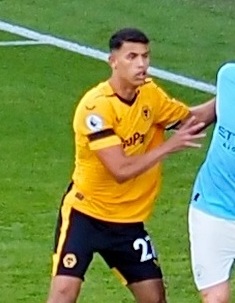
Matheus Nunes — photo by Bex Walton (CC BY 2.0), via Wikimedia Commons.

Open the global rankings on this site today and the best footballer in the world is a player you might not be able to pick out of a crowd. Not Kylian Mbappé. Not Jude Bellingham. By our numbers the top-rated player on the planet is Matheus Nunes — a midfielder at Manchester City, on 2628.6 — a very good footballer whom almost nobody would put in a conversation about the best five on Earth.
Look past him and the list reads like a roll-call of four clubs. Pedri (2621.6) and the teenager Lamine Yamal for Barcelona; Erling Haaland (2576.4) and Bernardo Silva for City; David Raya, William Saliba and Bukayo Saka for Arsenal; a cluster of Bayern Munich names. Nearly everyone in the top twenty plays for one of four relentless winning teams.
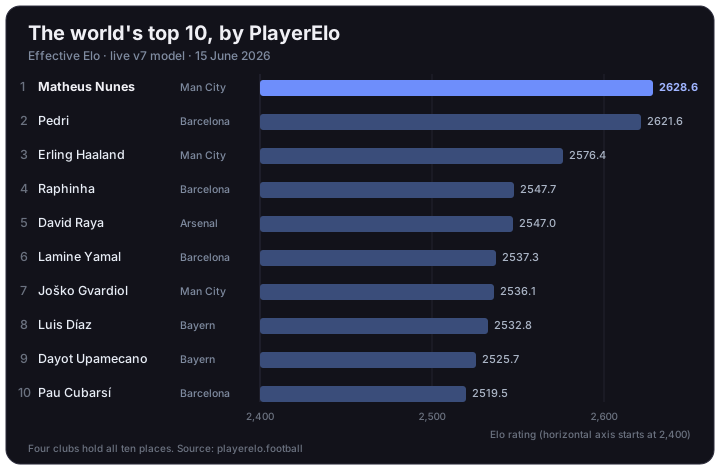
The top ten on 15 June 2026 — a tight cluster of elite numbers, and a closed shop of four clubs.
That pattern is not noise. It is the cleanest way to see what a player rating is, and what it isn't.
A PlayerElo rating is not a talent score. It is a forecast. The number exists to answer one narrow question: given who a player lines up alongside and against, how much has he been shifting his teams' chances of winning? Read that question literally and Matheus Nunes at the top stops being strange.
The number is a prediction, not a verdict
Elo rating began with chess — Arpad Elo's method for turning wins and losses into a single number that predicts the next result. Each game nudges your rating up or down, and the size of the nudge depends on how surprising the result was. Beat someone far below you and you gain almost nothing. Beat an equal and you gain more; lose to them and you bleed points.
The research on football ratings is built around that predictive test, not around reputation. Constantinou and Fenton's pi-ratings learn each team's strength from the margins of past results and are judged purely on how well they forecast the next match (Constantinou & Fenton, 2013). Models like PARX exist to turn those strengths into match probabilities and then check them against what actually happened (Angelini & De Angelis, 2017). The same logic stretches from teams down to individuals — the EA SPORTS Player Performance Index was an early attempt to score Premier League players on contribution rather than highlights (McHale et al., 2012), and researchers have since bent Elo itself to rate specific skills, like winning aerial duels (Kim & Kim, 2024). The yardstick never changes. Not "does this feel right." Does it predict. We hold our own model to that standard too: its match-outcome probabilities are checked against the closing prices of the sharpest bookmakers, the hardest forecasting benchmark football has.
One question, many compressions
PlayerElo gives an Elo to each of more than 76,000 players. The number moves with a player's team results, weighted by position and by minutes on the pitch. Strip away the machinery and it is doing what a whole family of football metrics does: compressing "did this player help his team win?" into a single figure.
They disagree, productively, on how. Data-driven valuation models predict a transfer price from performance and age, and have beaten the crowd's wisdom on its own turf (Müller et al., 2017) — though that same crowd, fans typing values into community sites, turns out to be a remarkably accurate evaluator in its own right (Herm et al., 2014). Expected goals strips a shot down to its chance of scoring and ignores whether it went in (Anzer & Bauer, 2021); later work has sharpened those models and shown their value across large match datasets (Mead et al., 2023). Possession-value frameworks go finer still, putting a number on every pass and carry by how much it shifts the chance of scoring next (Fernández et al., 2021) — fine enough to credit even an off-target shot for the danger it created (Baron et al., 2024). Plus-minus, borrowed from basketball and adapted to American football, asks the bluntest version: when this player was on the field, did his team do better (Sabin, 2021)? Different tools, one shared question.
PlayerElo actually carries two of these numbers. The headline Elo rewards being attached to winning football. A second figure — Elo Above Replacement — tries to isolate a player's individual value over a replacement-level peer in the same position. They can disagree, and on Matheus Nunes they do: our individual-value measure rates both Pedri and Haaland comfortably above him. He still tops the overall list, because that list also rewards being a near-ever-present in a team that simply keeps winning.
Why the top looks the way it does
So, back to Nunes. What do he, Pedri, Haaland, Raphinha and Raya actually share? Not fame. Minutes, and winning.
Nunes has played nearly three hundred games for a Manchester City that wins most weeks. Pedri has spent his whole career inside a dominant Barcelona. A goalkeeper like Raya cracks the top five because he stands behind a mean, well-drilled Arsenal defence that manufactures a lot of clean results. The rating is rewarding precisely what it claims to: playing a great deal, for sides that keep winning, against the specific opponents they faced. A gifted forward dragging a mid-table team to tenth is, by this measure, attached to a worse stream of results — so he ranks lower. That is not the rating failing. It is the rating being honest about a deliberately narrow idea of value.
What it cannot see
The same honesty cuts the other way. A rating's blind spots are not failures to apologise for; they are the edges of what the number is allowed to know.
The sharpest edge is cross-league comparability — and here a confession is the best teacher. The best-rated player in the Saudi Pro League, Theo Hernández, sits 37th on our global list. An earlier version of this same model, only a day before I write this, had him at number one. Refining how we separate a player's long-run rating from his short-term form moved him from the summit into the thirties overnight. A rating that lurches when its own assumptions change is not malfunctioning; it is reminding you that it was always a model's best estimate, never a fact about the world.
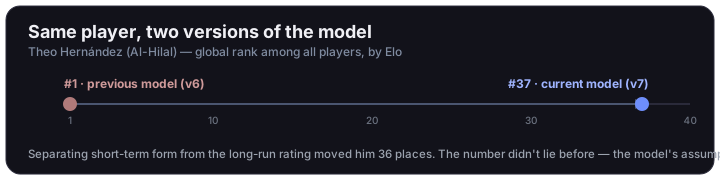
The same player, before and after one methodology change — the clearest reminder that a rating is an estimate, not a fact.
Cross-league comparison is exactly the kind of thing those assumptions wrestle with. Elo only ever meets an opponent through the graph of who has played whom, and the Saudi league rarely crosses Europe, so the bridge between their rating scales is thin — a number printed to one decimal place can still hide league-sized uncertainty underneath. League strength genuinely varies in ways that resist measurement; even something as basic as home advantage differs across 157 national leagues (Pollard & Gómez, 2014), and Elo ratings for national teams are only as trustworthy as the cross-border play binding them together (Gásquez & Royuela, 2016). The problem is real enough that reformers have argued for rebuilding UEFA's own club coefficients on an Elo-style footing to handle it better (Csató, 2023).
Then there is randomness. A football result is a noisy reading of performance. A deflected ninetieth-minute winner and a thoroughly deserved one move the rating by the same amount, because the rating sees only the scoreline. The point has been made bluntly: outcomes in club football carry enough luck that judging players on them alone is a mistake, which is the very reason expected-goals measures exist (Brechot & Flepp, 2020).
There is attribution. The rating takes a team result and parcels it out to individuals, so home advantage (Fischer & Haucap, 2021), the quality of teammates, and a coach's tactics all bleed into one player's number. Possession-value research exists precisely to recover the build-up play that an outcome-based figure throws away (Fernández et al., 2021). And there is role: a midfielder's 2628.6 and a goalkeeper's 2547.0 are not the same job measured twice. We weight for position, but weighting is still a kind of flattening.
Read the number for what it is
None of this makes the ranking useless. It makes it legible. Matheus Nunes at the top is not a glitch to wince at; it is the rating telling you exactly what it can see — a great deal of winning football — and admitting what it cannot, like whether a goal in Riyadh should count for as much as one in Manchester.
So read your favourite player's number as a forecast with error bars, not a final grade. It is a disciplined, testable estimate of how much he has been tilting his teams' odds, given the company he has kept. The ranking is the least interesting thing it offers. The discipline underneath it — and the honesty about its limits — is the whole point.
References
- Constantinou, A. C., & Fenton, N. (2013). Determining the level of ability of football teams by dynamic ratings based on the relative discrepancies in scores between adversaries. Journal of Quantitative Analysis in Sports. https://doi.org/10.1515/jqas-2012-0036
- Angelini, G., & De Angelis, L. (2017). PARX model for football match predictions. Journal of Forecasting. https://doi.org/10.1002/for.2471
- McHale, I. G., Scarf, P., & Folker, D. E. (2012). On the Development of a Soccer Player Performance Rating System for the English Premier League. INFORMS Journal on Applied Analytics. https://doi.org/10.1287/inte.1110.0589
- Kim, J., & Kim, S. (2024). Evaluating aerial duel ability of football players using height-adjusted Elo rating model. International Journal of Performance Analysis in Sport. https://doi.org/10.1080/24748668.2024.2420458
- Müller, O., Simons, A., & Weinmann, M. (2017). Beyond crowd judgments: Data-driven estimation of market value in association football. European Journal of Operational Research. https://doi.org/10.1016/j.ejor.2017.05.005
- Herm, S., Callsen-Bracker, H., & Kreis, H. (2014). When the crowd evaluates soccer players' market values: Accuracy and evaluation attributes of an online community. Sport Management Review. https://doi.org/10.1016/j.smr.2013.12.006
- Anzer, G., & Bauer, P. (2021). A Goal Scoring Probability Model for Shots Based on Synchronized Positional and Event Data in Football (Soccer). Frontiers in Sports and Active Living. https://doi.org/10.3389/fspor.2021.624475
- Mead, J., O'Hare, A., & McMenemy, P. (2023). Expected goals in football: Improving model performance and demonstrating value. PLoS ONE. https://doi.org/10.1371/journal.pone.0282295
- Fernández, J., Bornn, L., & Cervone, D. (2021). A framework for the fine-grained evaluation of the instantaneous expected value of soccer possessions. Machine Learning. https://doi.org/10.1007/s10994-021-05989-6
- Baron, E. J., Sandholtz, N., Pleuler, D., & Chan, T. C. Y. (2024). Miss it like Messi: Extracting value from off-target shots in soccer. Journal of Quantitative Analysis in Sports. https://doi.org/10.1515/jqas-2022-0107
- Sabin, P. (2021). Estimating player value in American football using plus–minus models. Journal of Quantitative Analysis in Sports. https://doi.org/10.1515/jqas-2020-0033
- Pollard, R., & Gómez, M. (2014). Components of home advantage in 157 national soccer leagues worldwide. International Journal of Sport and Exercise Psychology. https://doi.org/10.1080/1612197x.2014.888245
- Gásquez, R., & Royuela, V. (2016). The Determinants of International Football Success: A Panel Data Analysis of the Elo Rating. Social Science Quarterly. https://doi.org/10.1111/ssqu.12262
- Csató, Ł. (2023). Club coefficients in the UEFA Champions League: Time for shift to an Elo-based formula. International Journal of Performance Analysis in Sport. https://doi.org/10.1080/24748668.2023.2274221
- Brechot, M., & Flepp, R. (2020). Dealing With Randomness in Match Outcomes: How to Rethink Performance Evaluation in European Club Football Using Expected Goals. Journal of Sports Economics. https://doi.org/10.1177/1527002519897962
- Fischer, K., & Haucap, J. (2021). Does Crowd Support Drive the Home Advantage in Professional Football? Evidence from German Ghost Games during the COVID-19 Pandemic. Journal of Sports Economics. https://doi.org/10.1177/15270025211026552