Where FC Twente needs to spend the Rots money
2026-06-17
FC Twente is having the kind of summer most clubs would envy and dread in equal measure. The bank balance is healthy: Twente have just sold Mats Rots to 1899 Hoffenheim for a reported club-record fee — Transfermarkt lists €12m up front, with add-ons taking it toward €16m. Around that headline, two more first-teamers have gone: the veteran striker Ricky van Wolfswinkel has been let go on a free, and Ramiz Zerrouki's loan has lapsed, sending him back to Feyenoord.
Selling well is a good problem. But it is still a problem, and the interesting question is not whether Twente strengthen this window — it is where. A side that finished in the top half of the Eredivisie does not have many holes, and the easiest mistake after a big sale is to reinvest the money where the squad is already strong. So we put a narrow question to a cross-league player rating — one that scores some 76,000 footballers on a single scale: after the departures, where does Twente actually need to spend?
A strong squad, not a weak one
Start with what the sale is not. Twente are not rebuilding from rubble. On the rating the squad's median sits at 1799 — comfortably in the upper half of the division — and, line by line, there is no soft spot to paper over. Defence, midfield and attack all sit clearly above the Eredivisie's middle; even after a summer of outgoings, this is a team with a floor.
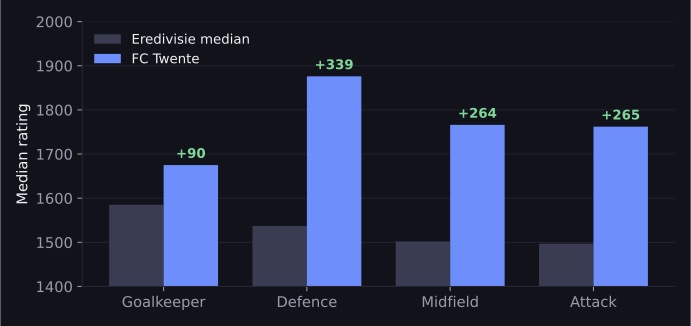
FC Twente's squad against the Eredivisie median, by line. Every department sits above the division's middle — this is strengthening from strength, not a rescue job.
That matters for how you read the rest. When a strong squad sells, the danger is buying the most available name rather than filling the gap the sale actually opened. The discipline is to let the hole, not the market, decide the search.
One hole stands out
The departures do not divide evenly. Rots was not a rotation piece; on the positional model he was Twente's only specialist left-back, and a good one — comfortably above the league at the position. Sell him and the slot is not thinned but emptied. Of the five priorities the model surfaces, left-back is the only one it flags as critical: there is, right now, no senior like-for-like behind the man who left.
The other two exits sting less. Van Wolfswinkel's release leaves Sam Lammers as the lone senior centre-forward — thin enough to want a partner, but not bare. Right-back is similar: Bart van Rooij is in excellent form, yet he too is the only specialist, so an injury there would bite. Zerrouki's exit barely registers: the midfield keeps its depth behind Kristian Hlynsson, and the rating sees no gap there worth a fee. The shape of the window, then, is one critical job — left-back — two that are merely prudent (a striker, cover at right-back), and a couple of squad upgrades behind them.
Filling the flank — and what it costs
So the Rots money has an obvious first claim on it: a left-back good enough to start. The model's affordable shortlist for the role spans the markets a Dutch club can realistically shop — Belgium, the Czech top flight, Scandinavia, Serbia — and three names frame the choice.
At the top end, Flávio Nazinho of Cercle Brugge is the ready-made starter: rated near Eredivisie level, in strong form, twenty-two years old — and, at a market value around €6m, exactly the kind of signing the Rots fee exists to fund. If Twente would rather spread the money, the value play is Merchas Doski at Viktoria Plzeň: a near-identical rating, the best recent form of any name on the list, for under €2m. And for a club minded to gamble small, a capable Serbian-league left-back can be had for €600k. Same position, a tenfold spread in price — which is precisely the decision a healthy budget buys you.
That budget, for the record, is real. Pricing a realistic single-signing ceiling off Twente's own squad values puts it near €7m — above every name the model returns. This is not a club forced to hunt for value because it is broke; it is a club that can afford to do the left-back properly and still have change for a striker.
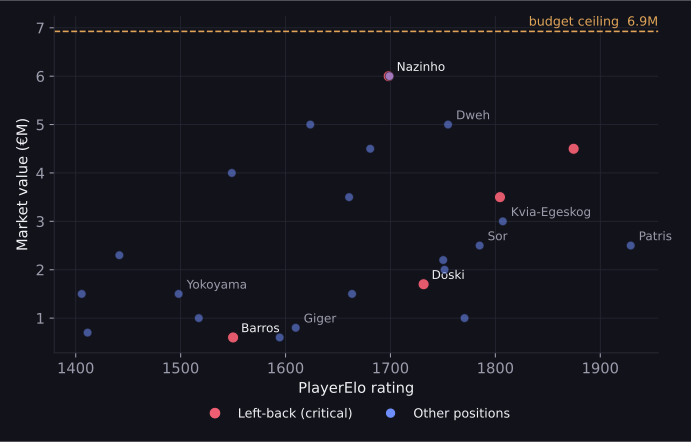
The affordable shortlist across all five positions: rating against live market value (June 2026). The critical left-back targets are highlighted; everything sits under the club's ceiling — here the constraint is fit, not price.
The rest of the list fills in around that priority. Up front, Younes Sor at Genk is the sharpest stylistic match for a mobile centre-forward at €2.5m, with cheaper depth in Belgium if the budget tightens. At right-back, Loïc Patris of Union Saint-Gilloise tops the board on both rating and fit. And in the wide roles — upgrades rather than needs — the eye-catcher is Ayase Yokoyama, another Genk man, whose rising form and €1.5m tag read like a classic Eredivisie-ready bet. The full board:
| Position | Player | Club (country) | Rating | Value | Read |
|---|---|---|---|---|---|
| Left-back | Flávio Nazinho | Cercle Brugge (Belgium) | 1698 | €6.0m | Ready starter, top of budget |
| Left-back | Merchas Doski | Viktoria Plzeň (Czech) | 1732 | €1.7m | Best form on the list, value |
| Left-back | Lucas Barros | Vojvodina (Serbia) | 1550 | €600k | The gamble — cheap, capable |
| Right-back | Loïc Patris | Union SG (Belgium) | 1929 | €2.5m | Best rating and fit |
| Right-back | Sekou Dweh | Viktoria Plzeň (Czech) | 1755 | €5.0m | Rising form, pricier |
| Striker | Younes Sor | Genk (Belgium) | 1785 | €2.5m | Sharpest like-for-like |
| Striker | Marco Giger | Union SG (Belgium) | 1610 | €800k | Cheap depth option |
| No. 10 | Sondre Kvia-Egeskog | Viking (Norway) | 1807 | €3.0m | Highest-rated playmaker |
| Winger | Ayase Yokoyama | Genk (Belgium) | 1498 | €1.5m | Form and value |
| Winger | Jasper Margaritha | SK Beveren (Belgium 2) | 1771 | €1.0m | Highest-rated wide option |
The signing, and how the data reads it
While this was being written, Twente acted on exactly that priority: they signed a left-back, Aske Adelgaard, the 22-year-old Dane at GO Ahead Eagles, for a reported €1m. It is a sensible first move. On the rating he is a solid Eredivisie-level full-back — 1660, comfortably inside the band the model drew for the role — and at twenty-two he fits the resale profile a club reinvesting a record fee should want. He is also, plainly, a level below the man he replaces: Rots left at 1939, and Adelgaard arrives nearly three hundred points lower, on form that has dipped rather than climbed. Read it as the first brick in a rebuild, not a like-for-like.
The honest footnote is that our own shortlist did not name him — and the reason is instructive. The model shops the markets below a club's own division: the Eerste Divisie, Belgium, Scandinavia, the places value hides. It does not scan the Eredivisie itself, on the logic that you rarely strengthen by buying a same-league rival at the same level. Adelgaard is precisely that — a domestic signing — so he sat outside the search by design. The sieve pointed, correctly and emphatically, at left-back; the club found its man in a market the sieve doesn't cover. Both are true, and both are worth knowing.
What the rating cannot see
Two honest caveats, briefly. The rating measures the level a player has earned from results; it does not watch him, and it cannot judge the quality of a striker's chances — goals and shots it has, expected goals it does not, which is the very reason that signal exists (Brechot & Flepp, 2020). And the cross-league comparison that makes a Serbian or Czech left-back legible next to an Eredivisie one is also where its error bars are widest: the thinner the competitive bridge between two leagues, the more a tidy number can hide (Gásquez & Royuela, 2016). None of this is a verdict. It is a sieve — a way to walk into the video and the due diligence already knowing where to point them.
For Twente, though, the sieve is unusually clear. The squad is strong, the money is there, and the priority is not in doubt: spend the bulk of the Rots fee on the position Rots vacated, and the rest of the window looks after itself.
We ran the same exercise for a club at the other end of the table — PEC Zwolle, where the gap was quality, not depth. Curious whether the numbers see your club the way you do? Get in touch.
References
- Brechot, M., & Flepp, R. (2020). Dealing With Randomness in Match Outcomes: How to Rethink Performance Evaluation in European Club Football Using Expected Goals. Journal of Sports Economics. https://doi.org/10.1177/1527002519897962
- Gásquez, R., & Royuela, V. (2016). The Determinants of International Football Success: A Panel Data Analysis of the Elo Rating. Social Science Quarterly. https://doi.org/10.1111/ssqu.12262