Messi Is Our 1,233rd-Best Player. By Another Measure, He's 2nd in the World.
2026-06-17
By the headline number on this site, Lionel Messi is the 1,233rd-best footballer alive. By another number we keep right next to it, he is the second-best on the planet. Same player, same database, same afternoon — 17 June 2026. Both numbers are doing their job. The distance between them is the whole point.
The famous number is Elo. Messi's sits at 1,996, a long way below the 2,628 at the top of our list of more than 72,000 rated players. The other number is Elo Above Replacement — EAR — and on that one he trails exactly one man. EAR is the closest thing football has to baseball's WAR: a single figure for how much a player is worth on his own, scrubbed of how good his team happens to be. Once you know which question each number is answering, ranking Messi 1,233rd and 2nd at the same time stops being a contradiction and starts being the most useful thing the model can tell you. (Both numbers move every day; by the time you read this the exact ranks will have drifted. The gap is the durable part.)
Why the famous number leaves him in the eleven-hundreds
Elo measures one narrow thing, and measures it honestly: how much a player tilts his team's results, against the specific opponents he actually faces. It began as a chess rating — beat someone far above you and you climb, lose to someone you should have beaten and you bleed. Football ratings kept that predictive spine. Dynamic team ratings like Constantinou and Fenton's pi-ratings learn a side's strength from the margins of its past games and are judged only on how well they call the next one (Constantinou & Fenton, 2013); the same discipline runs through player-level work that learns each action's weight from a whole season of results rather than a highlight reel (Brooks et al., 2016). Our player Elo sits on that foundation, then splits the credit for every result across the lineup.
Read literally, Messi's 1,996 is not a verdict on his feet. It is a verdict on his fixture list. Inter Miami in MLS plays a schedule that rarely crosses Europe, so the bridge between that league's rating scale and the Premier League's is thin. Elo only ever meets an opponent through the graph of who has played whom, and that graph barely connects Fort Lauderdale to Manchester; pull the connecting fixtures away and a rating drifts toward the level of the league it is trapped in (Gásquez & Royuela, 2016). Put a player in a team that wins comfortably rather than relentlessly, against opponents the model already expects him to beat, and there is little surprise left for the rating to feed on. The model is not failing to see Messi. It is answering a question — how attached to top-level winning is he, right now — that simply isn't the question most people mean when they ask how good he is.
The question WAR was built to ask
Baseball ran into this wall decades ago. A win–loss record describes a team and buries the individual inside it, so sabermetricians built Wins Above Replacement to dig him back out: how many wins does this player add over a freely available stand-in, a journeyman you could sign for nothing? A brilliant pitcher marooned on a hopeless team still posts a huge WAR, because WAR was designed to ignore the team and isolate the man.
EAR is that idea in football. For every match a player completes, we take his performance rating, ask how far it sits above or below the average for his position, and turn that gap into a small credit or debit. Sum it over a career and you have a number that asks: everywhere he has played, against everyone he has faced, how far has this player out-performed a replacement-level peer in his role? Messi's total is +136.5. Only Joshua Kimmich sits higher.
That total is a floor, not a ceiling. Our match-rating data only reaches back to 2015; Messi made his Barcelona debut in 2004, so the +136.5 sums his matches from age 28 onward and counts nothing from the decade that brought four straight Ballons d'Or. His real career figure would dwarf it. Cristiano Ronaldo carries the same buried prime — his record here only opens a dozen years into his career. Kimmich is the tell: his top-flight career began almost exactly when our data does, so his +138.4 hides no missing years, and that, as much as anything he does on the pitch, is why he noses ahead at the top.
What "above replacement" actually means here
The machinery is worth seeing, because it changes how you read the number. Each position carries an average match rating — 6.85 for a midfielder, a shade higher for goalkeepers — and a spread around it. A player's rating for a single game becomes a z-score: how many standard deviations above or below his position's norm he played. That z-score runs through a deliberately steep curve, 1 + 0.33 · tanh(z / 0.05), and the output is his EAR for the day.
Two things fall out of that, and both matter. The curve is sharp. A midfielder who earns a 7.2, against a 6.85 average, already pins it at the ceiling of +0.33; one who gets a 6.5 bottoms out near −0.33, and the band in between is narrow. So EAR per match is close to a yes-or-no verdict — above your position's bar, or below it — and a career EAR is, near enough, 0.33 times how many more above-bar games you have played than below-bar ones. Messi's +136.5 across 466 rated matches works out to +0.29 a game, which is another way of saying he has cleared his position's bar in the great majority of them, season after season, league after league.
The second thing: this factor isn't only a display number. Inside the engine it decides each player's share of his team's Elo swing — outplay your position in a win and you take a bigger slice of the gain; underperform in a defeat and you wear more of the loss. EAR is the running total of that re-weighting, which is why it carries the word Elo. The name is fair, with one caveat worth saying out loud: baseball's "replacement" is a sub-average scrub, while our zero point is the position average. "Above replacement" here really means "above a typical professional in the role" — a stiffer bar than the borrowed term suggests.
One model, two leaderboards
Lay the two numbers side by side across the whole database and they describe different worlds.
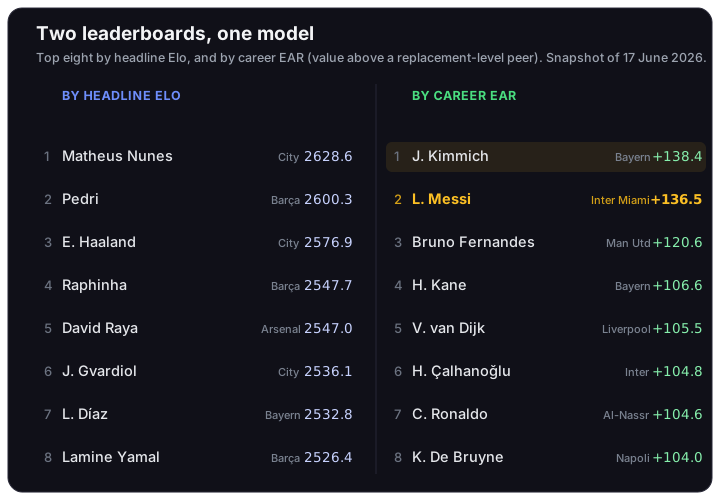
The same model, two questions. Left: who is most attached to elite winning. Right: who has been most valuable above a replacement-level peer, team stripped out. Snapshot of 17 June 2026.
The Elo top is a closed shop. Matheus Nunes, Pedri, Erling Haaland, David Raya — nearly everyone near the summit plays for Manchester City, Barcelona, Arsenal or Bayern Munich, four sides that win most weeks against the strongest opponents on offer. That is precisely what Elo is built to reward, and it rewards it well.
The EAR top is a different room. Kimmich leads it, but right behind Messi come Bruno Fernandes at a mid-table Manchester United, Harry Kane, Virgil van Dijk at Liverpool, Ronaldo in the Saudi Pro League, Kevin De Bruyne at Napoli. Not one of them is being carried by a winning machine; several are dragging ordinary teams uphill. Bruno Fernandes is the cleanest case of all — third in the world by EAR while his club hovers in mid-table, the exact "great player, average team" that WAR was invented to make visible.
The split shows up even between neighbours at the very top. Matheus Nunes holds our overall number one on 2,628, yet his EAR rates him only Good: a creditable +17.7 over 193 games, about +0.09 a match. Pedri, one rung below him on Elo, has banked +48.4 from 254 games at more than double that rate, and rates Elite. The headline list and the value list agree that both are excellent. They disagree, sharply, on which of them has been doing more of the work.
A fair warning about that EAR board: like every career counting stat, it rewards longevity, so it fills up with players who have 400-plus elite games behind them. The per-match rate is the age-blind version — and on rate, Messi's +0.29 actually edges Kimmich's +0.28, the peak just shading the compiler. It is the same argument baseball has every winter about career WAR versus WAR per season, transplanted whole.
Watching value move
A career sum is a verdict. Form is a film. We now stamp every recent match with its EAR over the prior 180 days and draw it as a green-and-red strip directly beneath a player's Elo line, one bar per game — green when he has been clearing his position's bar lately, red when he has slipped under it.
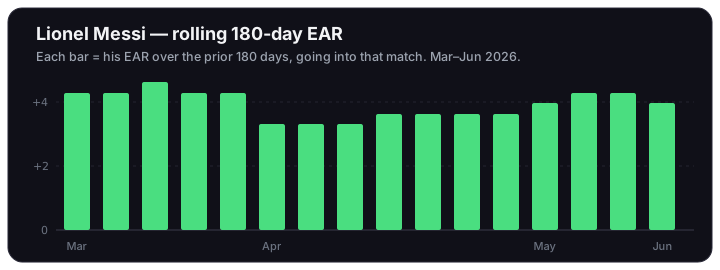
Messi's rolling 180-day EAR, recent matches. A flat wall of green near +4 — steady above-replacement form — while his headline Elo idled in the nineteen-hundreds. The same strip sits under every player on the site.
Messi's strip is a wall of steady green at around +4, holding flat while his headline Elo idles in the nineteen-hundreds. That picture is the whole article in miniature: a player whose individual form never wavered, tethered to a team-level number the league around him keeps capped. The strip isn't decoration, either. The live model leans on that 180-day form when it prices an upcoming match — a short-term nudge laid on top of the slow base rating. Since our most recent model version we hold the two strictly apart, so a hot month lifts a prediction without quietly inflating the long-run number underneath it. Form and class are allowed to disagree, and the strip is where you watch them do it.
What the number can't do
EAR carries a weakness it cannot fix: it is built on a match rating we do not own. The per-game score arrives from a third-party feed as a single figure from 0 to 10, with its own tastes — it warms to a goal and a clean sheet, and under-credits the quiet structural work that never reaches the scoreline. EAR normalises that rating by position; it does not rebuild it from the raw game. The richer methods in the literature do exactly the rebuilding EAR skips — valuing every pass for the danger it creates (Bransen et al., 2019), rating where a player chooses to stand rather than only what he does on the ball (Dick & Brefeld, 2019), or assembling a bespoke impact metric straight from event data (El-Sharkawi et al., 2025). Set against those, EAR is a careful normalisation of someone else's opinion, not a contribution model grown from first touches. The trade buys breadth — it works for a player in Paraguay as readily as one in Munich — and pays for it in depth.
The attribution problem bites here too. A match rating still answers, however roughly, "how did this individual play." But the instant EAR uses it to carve up a team's Elo swing, the wall every plus-minus metric runs into comes back: peeling one footballer's contribution off his teammates' is genuinely hard, and weighted plus-minus models spend most of their effort fighting that exact confound (Schultze & Wellbrock, 2017). And the position baseline travels uneasily across borders — a 7.2 in MLS and a 7.2 in the Premier League are scored against the same global average, which quietly assumes a midfielder's par is the same everywhere. That is a defensible assumption. It is not a true one.
None of this is buried. It is the edge of what the number was built to know, and naming the edge is the reason it is worth publishing.
Read both numbers
Elo and EAR are not rivals, and neither is the "real" one. They are two honest answers to two different questions. How attached to top-level winning is this player, right now? — that is Elo, and on it Messi is genuinely the 1,233rd name on the list. How much has this player been worth, wherever he has played, with his team stripped out? — that is EAR, and on it he stands second on Earth. Most footballers land in roughly the same spot on both, and for them the headline number is all you need. The interesting ones are those who don't: the star marooned in a weak league, the metronome propping up an average team, the teenager whose form is climbing faster than his club's results. Football's WAR will not crown a GOAT or win you an argument in the pub. It will tell you something a trophy cabinet cannot — how good a player has actually been, on his own terms — and it will be honest about the difference.
References
- Constantinou, A. C., & Fenton, N. (2013). Determining the level of ability of football teams by dynamic ratings based on the relative discrepancies in scores between adversaries. Journal of Quantitative Analysis in Sports. https://doi.org/10.1515/jqas-2012-0036
- Brooks, J. D., Kerr, M., & Guttag, J. V. (2016). Developing a Data-Driven Player Ranking in Soccer Using Predictive Model Weights. https://doi.org/10.1145/2939672.2939695
- Gásquez, R., & Royuela, V. (2016). The Determinants of International Football Success: A Panel Data Analysis of the Elo Rating. Social Science Quarterly. https://doi.org/10.1111/ssqu.12262
- Bransen, L., Van Haaren, J., & van de Velden, M. (2019). Measuring soccer players' contributions to chance creation by valuing their passes. Journal of Quantitative Analysis in Sports. https://doi.org/10.1515/jqas-2018-0020
- Dick, U., & Brefeld, U. (2019). Learning to Rate Player Positioning in Soccer. Big Data. https://doi.org/10.1089/big.2018.0054
- El-Sharkawi, M., Khan, T. A., & Ali, R. H. (2025). Crafting a Player Impact Metric through analysis of football match event data. Journal of Computational Mathematics and Data Science. https://doi.org/10.1016/j.jcmds.2025.100115
- Schultze, S., & Wellbrock, C. (2017). A weighted plus/minus metric for individual soccer player performance. Journal of Sports Analytics. https://doi.org/10.3233/jsa-170225